Jude Fokwang, PhD, Regis University
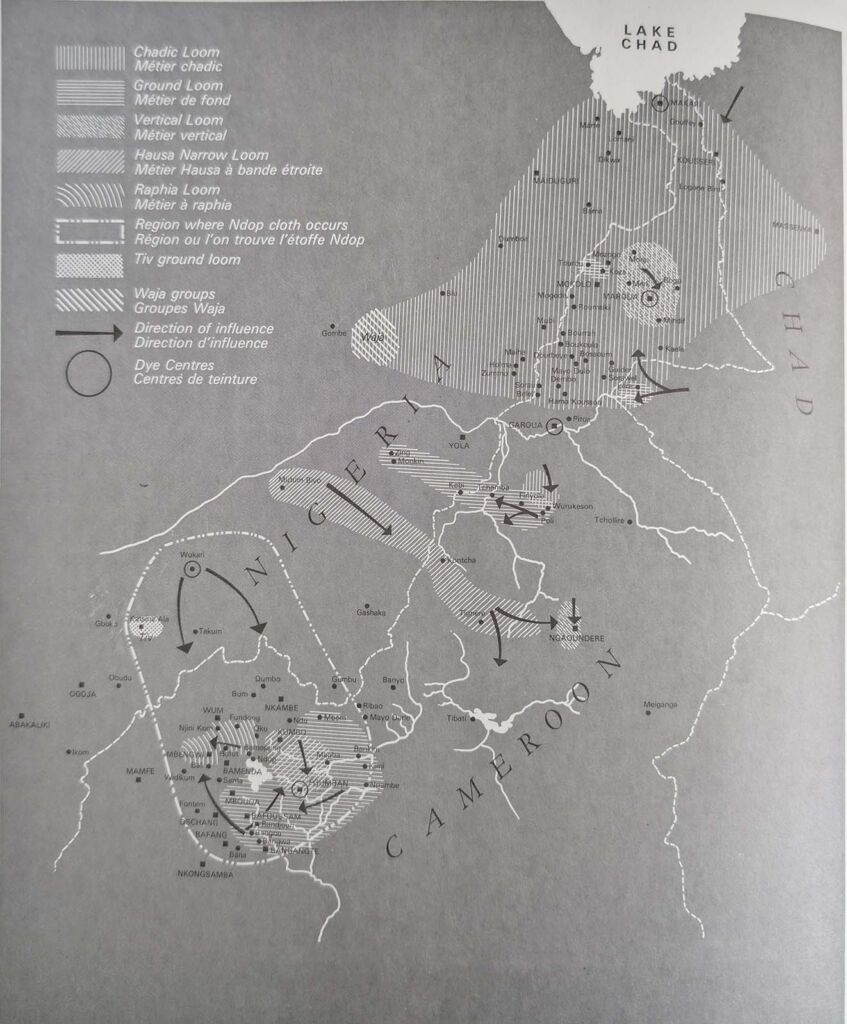
Archival and oral sources suggest that the origins of the Bamenda gown (toghu) cannot be reduced to a single point of invention.[1] Rather, its emergence, like that of the ndop cloth, is deeply connected to historical trade and migration routes linking what is today northern Cameroon with the Benue region of Nigeria. Kisob’s article (1963, p. 55) identifies a historical period and the groups that played a prominent role in introducing the gown to the Cameroon Grassfields. Specifically, he argues that the Bamenda costume was introduced around the middle of the nineteenth century by the Bali, who brought “bright colourful robes” from Chamba, a region he incorrectly locates in contemporary northern Nigeria (Sardauna Province of Northern Nigeria) (Kisob, 1963, p. 55). It should be noted that the Bali who later settled in the Cameroon Grassfields migrated from the region now known as Tchamba, at the foot of the Atlantika Mountains, in an area slightly east of the present-day Cameroon–Nigeria border (Fardon, 1983, 1988; Fokwang, 2009; Nyamndi, 1988; see also Figure 1.1). Kisob further supports the Chamba origin claim by observing that Chamba terms are used to describe the costume’s components and varieties. Among these, toghu has become the most widely recognised appellation and now functions as a generic term for several variations of the Bamenda costume. Historically, the Chamba distinguished between the toghu, yadala and paliwa, which are discussed in greater detail elsewhere in this project.
Although Kisob’s written account remains the most authoritative to date, other authors, including Venice and Alastair Lamb (1981), as well as museum and textile sources, have added nuance to our understanding of the origins and evolution of the Bamenda costume. The Metropolitan Museum of Art in New York, for example, concurs that the forerunners of the “Grassfields gowns” were introduced by the Chamba (Metropolitan Museum of Art, 2025). The Met further notes that the design scheme of the toghu was likely adapted from Wukari royal cloth imported by Grassfields rulers from their Jukun neighbours. Similarly, the Smithsonian describes royal Grassfields cloth (ndop) as a luxury item introduced through nineteenth-century long-distance trade from the Upper Benue into Cameroon. It attributes such cloths—particularly ndop—to Abakwariga, Hausa-speaking craftsmen who had been assimilated into the Jukun kingdom in Wukari (Smithsonian, 2019). The Textile Museum of Canada also notes that Bamileke and Bamum peoples imported ndop cloth from Wukari, where it was produced by the Jukun, and that King Njoya encouraged local production around 1910 (Textile Museum of Canada, 2020).
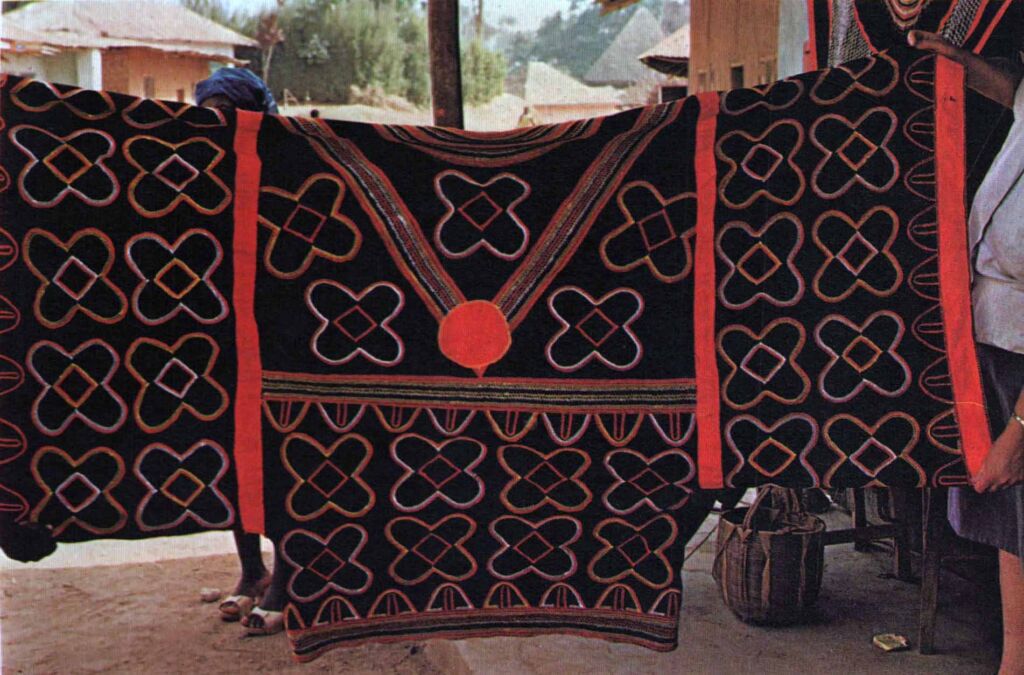
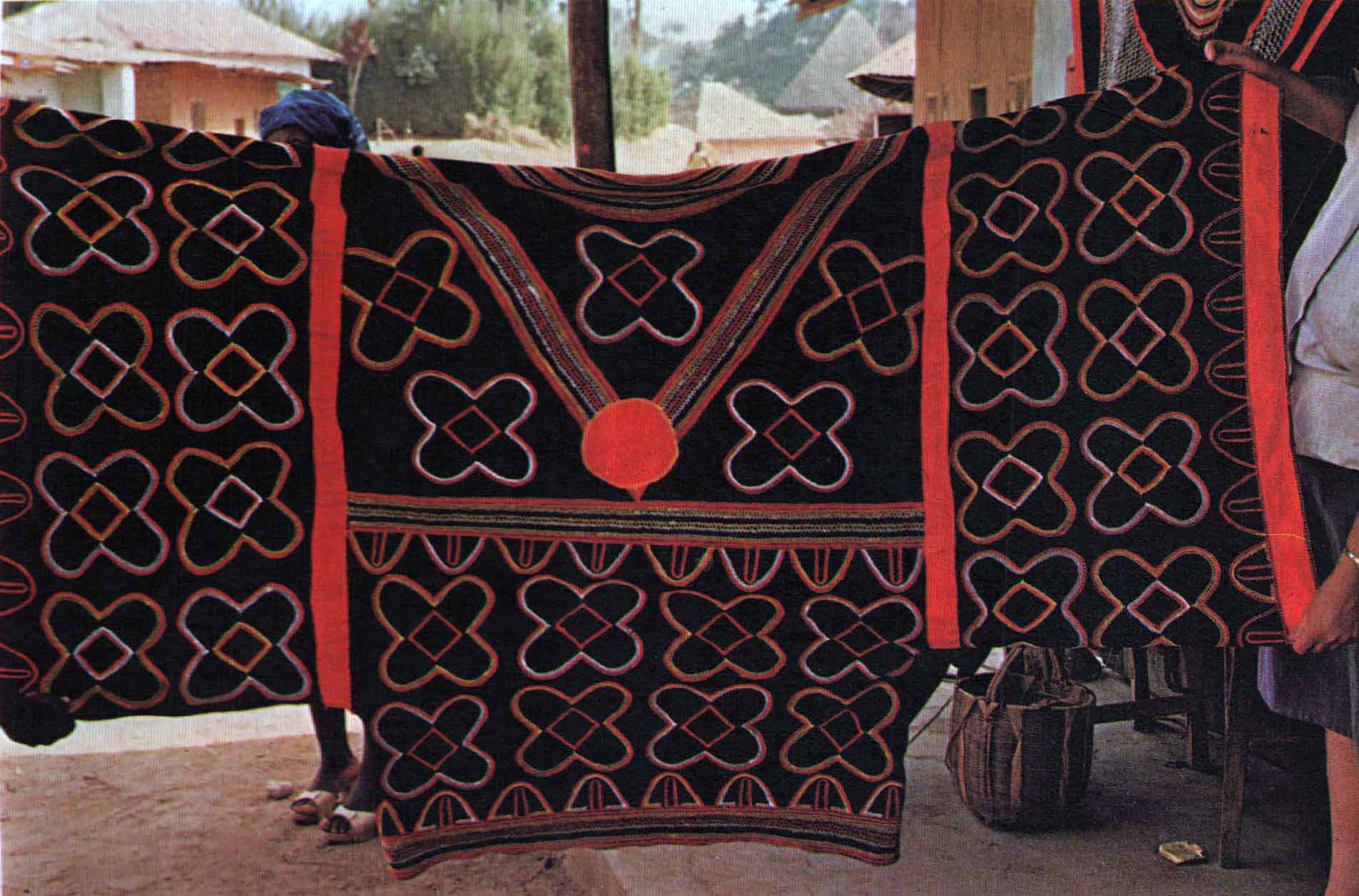
Toghu (Gown). Source: Venice and Alastair Lamb (1981)
An exhaustive account of the history and origins of the Bamenda gown (toghu) must also consider the ndop cloth, a key element in its production. Existing research suggests that, contrary to some claims in popular literature, what is known as ndop has Jukun-Wukari rather than Grassfields roots. An indigo-dyed cloth, ndop is known to have been imported throughout the nineteenth century by the Bamum from the Wukari region of Nigeria, where it was hand-woven and resist-dyed by the Jukun, who traditionally used it as a funeral shroud, or akya.
A third narrative, drawn from my January 2026 fieldnotes in Bafut, suggests a possible Tikari or pre-Chamba Grassfields origin. This claim may relate to the long-distance trade already noted between the Grassfields and the Wukari region. Although there is limited written evidence to substantiate an endogenous origin, the claim warrants further investigation, particularly because long-distance trade between Yola and the Wukari area extended beyond the Bamum kingdom to include peoples of the Western Grassfields. According to Kisob, pre-Chamba everyday wear in the Bamenda Plateau consisted of the “Ntum”—a simple piece of cloth worn as pants and held in place by a leather belt (Kisob, 1963, p. 55)—a perspective that complicates, and perhaps challenges, claims of endogenous origins.
Taken together, these sources point to what may be described as a layered origin model: Chamba/Bali migration influences, Wukari/Jukun/Hausa textile circuits, Bamum and Bamileke royal patronage, and local Grassfields reinterpretations all appear to have shaped the gown’s history. The toghu should therefore be understood not merely as an imported costume adopted by passive recipients, but as a regional artefact produced through mobility, exchange, courtly power and local aesthetic innovation. For more than a century, communities across the Grassfields have exercised agency in appropriating, redesigning and localising textile forms associated with the production and consumption of the toghu—a central concern of this work.
References
Fardon, R. (1983). A Chronology of Pre-Colonial Chamba History. Paideuma, 29, 67-92.
Fardon, R. (1988). Raiders & refugees: trends in Chamba political development, 1750-1950. Smithsonian Institution Press.
Fokwang, J. (2009). Mediating Legitimacy: Chieftaincy and Democratisation in Two African Chiefdoms. Langaa Research and Publishing.
Fokwang, J. (2014). Textile Archives: Traditional Gowns and Sociocultural Change in Cameroon.
Kisob, J. A. (1963). An Appreciation of Bamenda Traditional Costume. Abbia, 55-65.
Metropolitan Museum of Art, T. (2025). Prestige gown.
https://www.metmuseum.org/art/collection/search/315063
Nyamndi, N. B. (1988). The Bali Chamba of Cameroon: A Political History. CAPE.
Smithsonian. (2019). Display cloth. https://www.si.edu/object/display-cloth:nmafa_91-24-4
Textile Museum of Canada, T. (2020). Royal Display Cloth (Ndop), T94.3021. https://textilemuseum.ca/collection/royal-display-cloth-ndop-t94-3021/
[1] This is an excerpt from an ethnographic book manuscript under preparation based on my project (2014-2026): (Fokwang, J. (2014). Textile Archives: Traditional Gowns and Sociocultural Change in Cameroon and its Diasporas.